


I’m very early in my Substack journey. But already my brain is on overdrive, quietly (or sometimes loudly) plotting to sabotage my progress.
I made a conscious decision that 2026 is my year to start writing up my thoughts, ideas and develop skills to help me focus, and hopefully help other people in the process, using Refinding Focus as a platform and hook.
Part of that was to avoid obsessing about systems, waiting for things to be perfect, and just crack on. Keep it simple, publish somewhere easy, and let the content be the focus, rather than constantly obsessing over the process at the expense of progress.
Well it’s a week in, and my brain is already (unhelpfully) sewing the seeds of doubt…
Thoughts like:
What if everyone hates it
What if no-one reads it
What if anything happens to Substack… where does all the work go?
Shouldn’t I just post on my website directly
Maybe I should rebuild my website first
Oh, let’s reorganise the posts and ideas
What if your friends and family read this
It can make it quite difficult to focus.
Plus, with anything that feels ‘big’, it’s often super tough to get started but very easy to succumbing to any negativity and lose your momentum. That goes for whether it’s your own self doubt, or from others.
Now I’ve got a pretty thick skin for letting unhelpful external comments wash over me, but what about the noisy internal monologue. I think there’s a few parts to this, drawn from various reading and lessons over the years, and it starts from within…
Taming The Monkey
Your subconscious inner Monkey brain needs to be controlled. This is the concept about how the human brain evolved hundreds of thousands of years ago. Of course, the living conditions back then were somewhat different to today, with genuine threats of being attacked by wolves or hunting for the next meal.
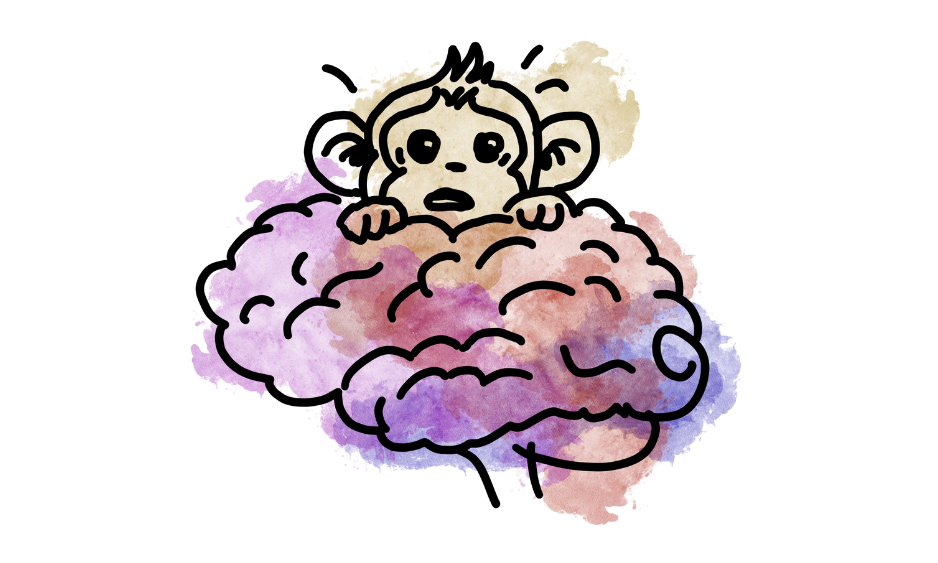
The Chimp Paradox book by Professor Steve Peters is perhaps the best and simplest way to think about this. In the book, he describes the brain as having three modes; The Chimp (emotions, danger, instinct), The Human (logic, reasoning) and The Computer (habits, beliefs).
The Chimp is the emotion driven part that we need to tame here. It’s the part of your brain that reacts to doing this ‘crazy new thing’. It isn’t malicious or broken. It’s just wired to avoid risk, embarrassment, and uncertainty.
The Chimp is trying to protect you, but unless it’s controlled, it actually hampers your progress and keeps you stuck. Fortunately humans are one of the only species that have the tools and thinking power to outsmart the Chimp!
Reducing the stakes
So essentially we’re dealing with a perceived threat here, rather than any significant real-world threats.
How to deal with this? Typically I’ll start by reducing the perceived threat:
Writing down the actual worst case scenarios
In the case of this Substack, the worst case is very low risk - either nothing happens, it fades into obscurity, or someone is so offended that I need to block them. Calmly assessing the risks helps quieten the chimp.Shrinking the risk, reducing the stakes
Remember, this isn’t forever. Nothing’s forever.
We can just try committing for a few months, see what happens and then decide then whether to continue.You’ve been here before
As life progresses, it’s easier to look back on the tough times, and remind yourself that you’ve conquered much bigger challenges in the past, and can do so again.Mitigating the tangible risks
A good example is if Substack changed their platform or model. What ways could mitigate that… well perhaps if I write all the articles locally on my Mac so I’ve got them all backed up, that would remove that particular risk… identifying the tangible risks and quickly reducing or avoiding them is key.
Sometimes it’s good for the monkey to take control - genuine danger, real physical risk, clear warning signs. But most of the time, in a modern online world, it’s reacting to imagined threats.
Reframing the doubt
To quote the wise Dr. Pepper “What’s the worst that can happen?”
OK so that’s pretty tongue in cheek, but it’s absolutely the right sentiment here. Can you commit to a short trial to see how it goes? Let’s just see what happens. Worst case, nothing… but even then, you’ll be learning, developing and improving so whatever comes next will be that much better.
Nothing’s set in stone forever. If it works, great. If not, change, adapt, go again and learn some more.
I hope this is useful if you’re struggling to refind your focus. I’ll be exploring more of these ideas in future posts.